Source occurrences
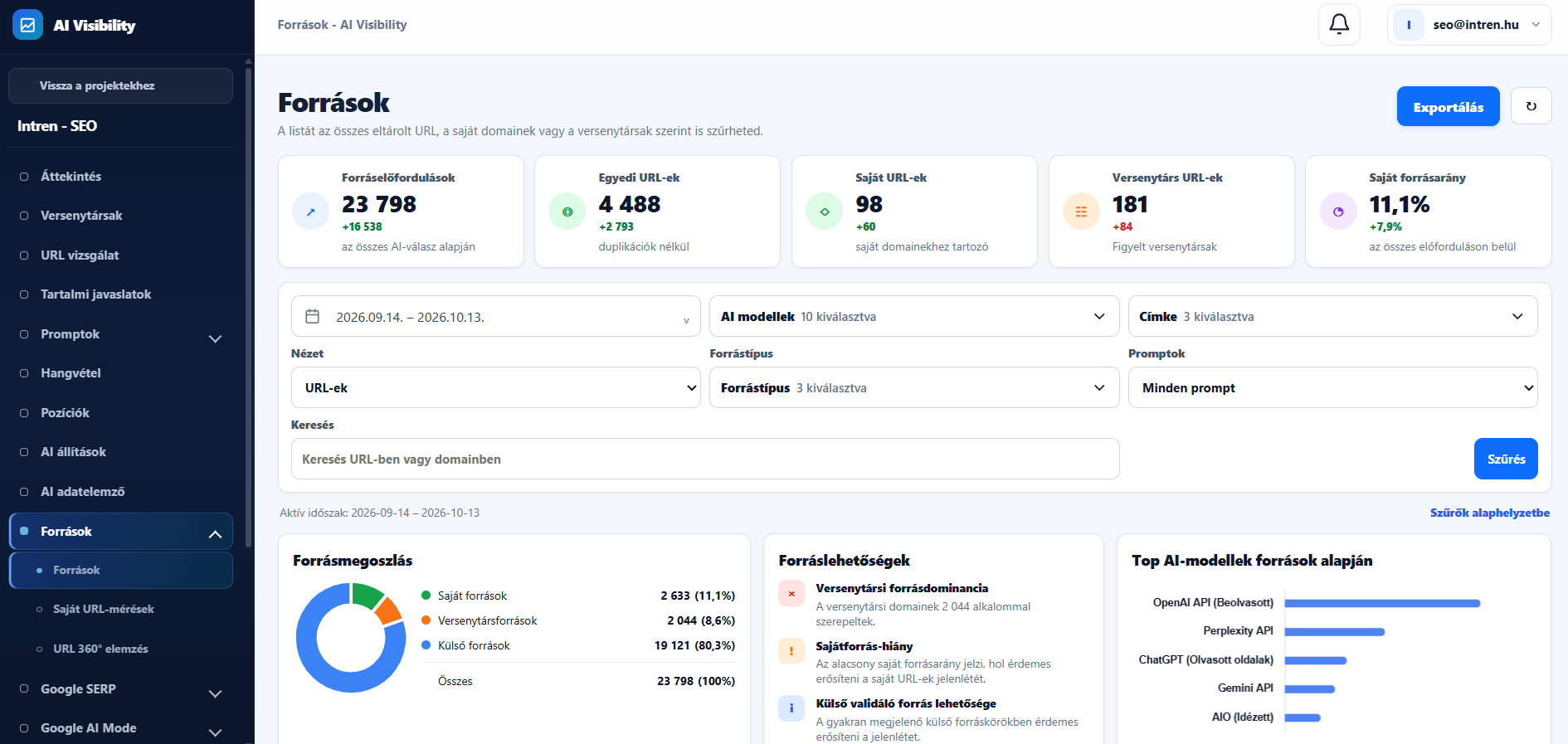
23,798Across the AI answers.
Find out which pages receive citations and how often your own website appears among them.
An advance subscription is required to use the service. Send your request using the form below.
 Explore the real Sources dashboard
API measurements and separately measured interfaces can produce different results. Measurements describe the configured prompts and retrieval context.
A brand mention and a citation to your website are separate signals. Domain and URL analysis makes the available references visible alongside the answer.
See which pages AI returns, how often it cites your own website and how clearly it identifies that source in its answers.
Across the AI answers.
Without duplicates.
URLs belonging to own domains.
URLs belonging to tracked competitors.
Own sources as a share of all occurrences.
Fixed project figures from the supplied admin screenshots, not a live report. Source occurrences, unique URLs and citing AI answers are separate data scopes. The original interface is in Hungarian.
Own sources appear 2,633 times, competitor sources 2,044 times and external sources 19,121 times. The overview also highlights source opportunities and ranks AI models by sources. Filter by period, model, tag, source type and prompt.
Open the full-size screenshot
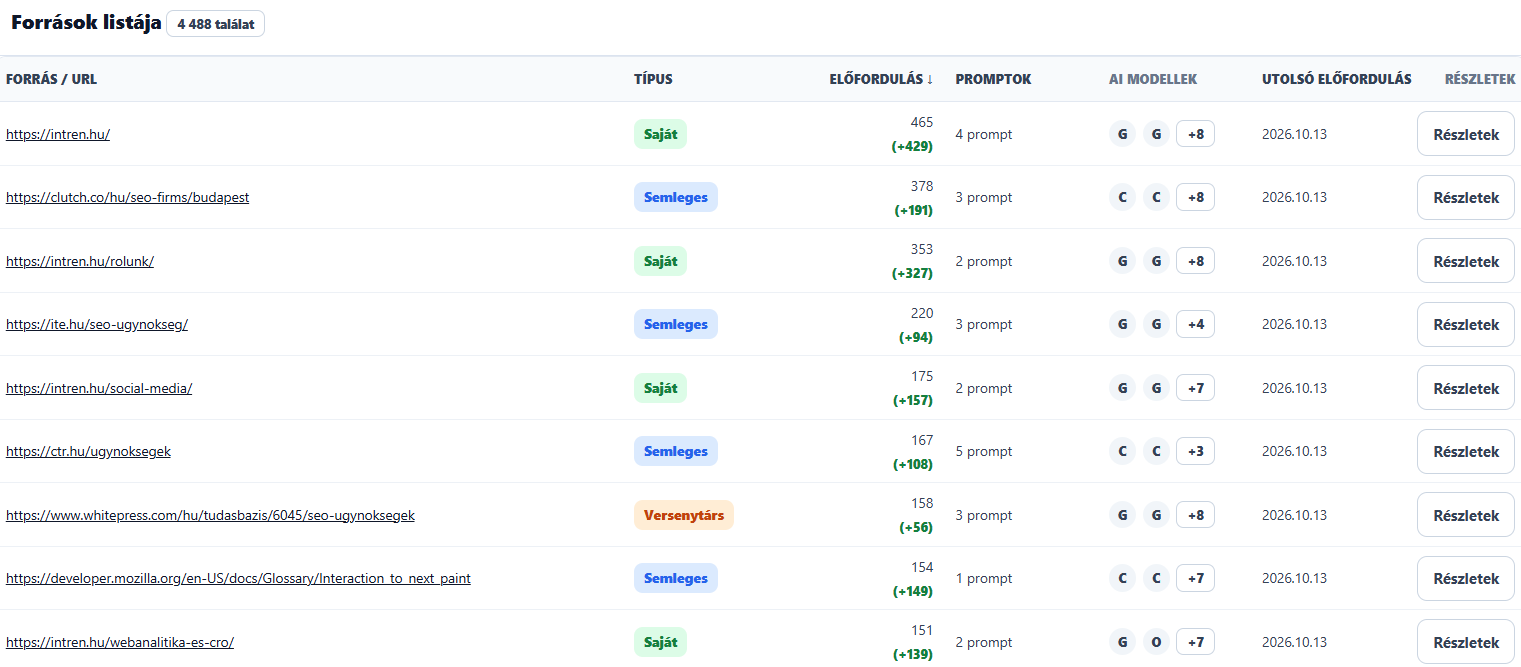
The list shows 465 occurrences for the intren.hu homepage and 353 for its about page. Each row includes source type, prompt count, AI models and last occurrence, with separately accessible details. Classification follows the project’s own and competitor domain settings.
 Open the full-size screenshot
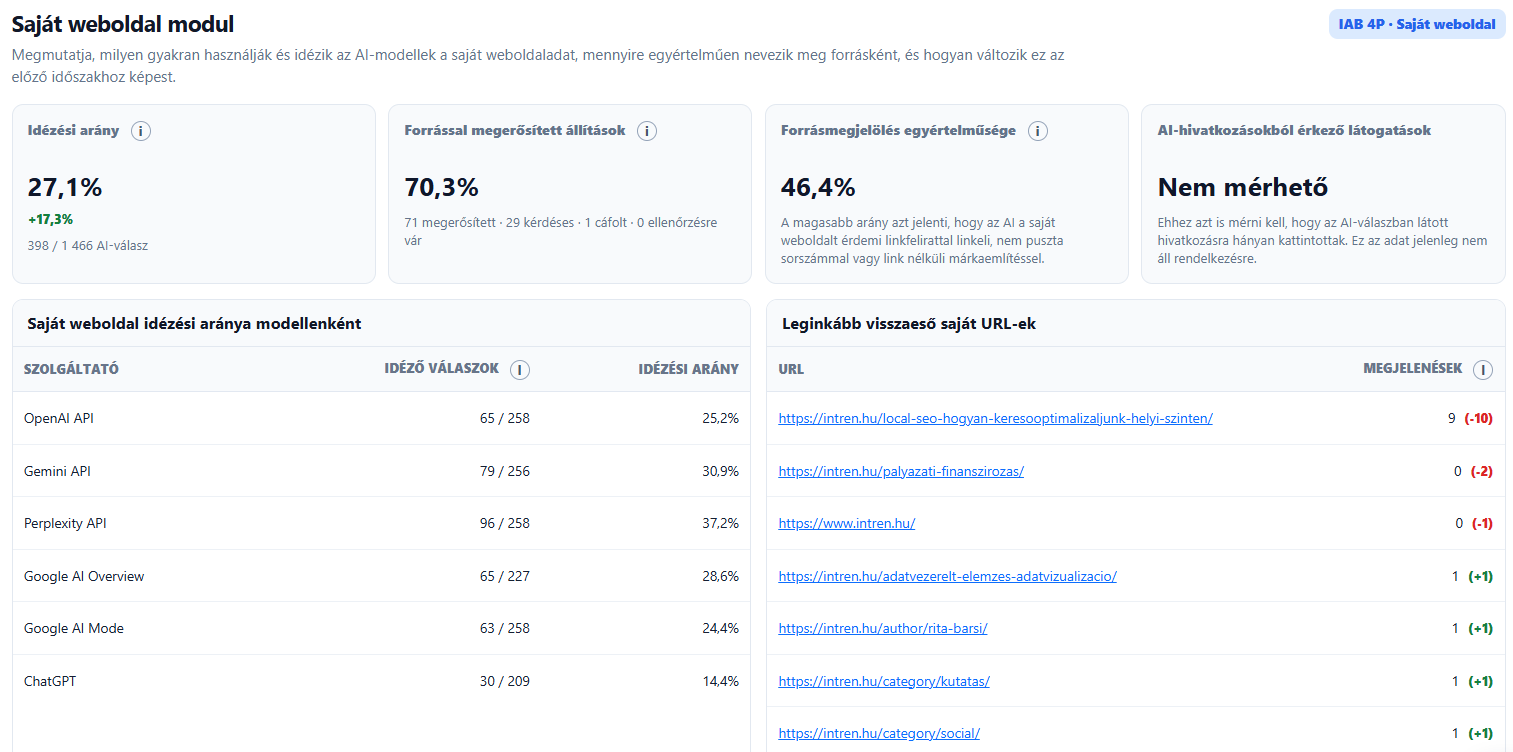
The own-site citation rate is 27.1%: 398 of 1,466 AI answers. The module provides a model breakdown, a 70.3% source-supported claim rate and 46.4% reference clarity. Declining own URLs appear in a separate list. Visits from direct AI citations are not measurable here.
 Open the full-size screenshot
| AI model | Citing answers / examined answers | Citation rate |
|---|---|---|
| OpenAI API | 65 / 258 | 25.2% |
| Gemini API | 79 / 256 | 30.9% |
| Perplexity API | 96 / 258 | 37.2% |
| Google AI Overview | 65 / 227 | 28.6% |
| Google AI Mode | 63 / 258 | 24.4% |
| ChatGPT | 30 / 209 | 14.4% |
This breakdown shows the six providers in the own website module; the overview’s ten selected source scopes are a different breakdown. The 11.1% source share uses 23,798 source occurrences as its denominator; the 27.1% citation rate uses 1,466 AI answers. One answer can cite several URLs.
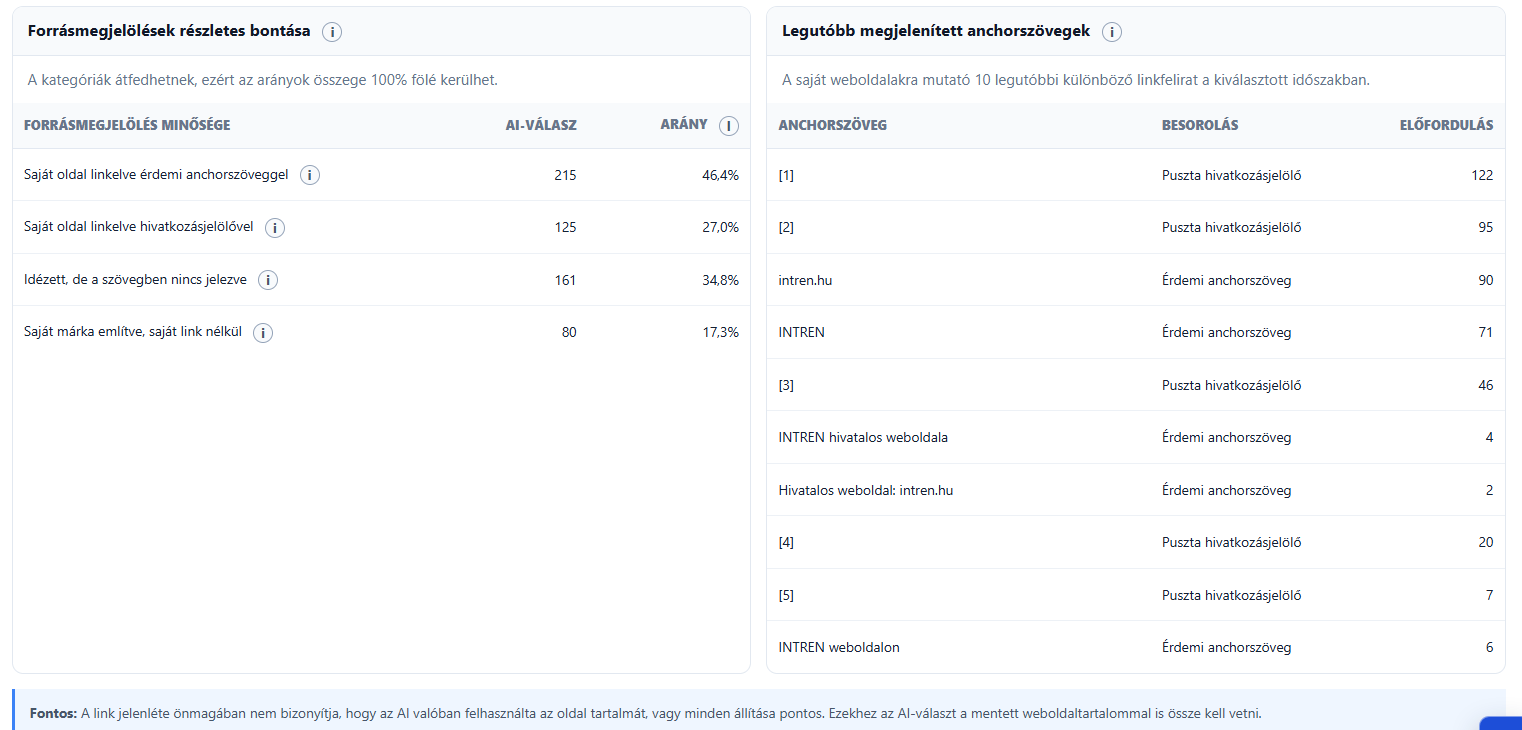
The breakdown distinguishes meaningful anchor text, numbered reference markers, citations without an in-text marker and brand mentions without an own-site link. The anchor list separates “intren.hu” and “INTREN” from markers such as “[1]”. Categories can overlap, so their percentages may sum to more than 100%.
 Open the full-size screenshot
A link alone does not prove that AI used the page’s content or that every claim is accurate. Compare the saved AI answer with the saved website content to assess this.
The Intren – SEO example contains 23,798 source occurrences across 4,488 unique URLs. Its 2,633 own-source occurrences represent an 11.1% source share, while its own-site citation rate is 398 / 1,466 AI answers, or 27.1%. The percentages describe different data scopes.
Fixed project figures from the supplied screenshots for September 14–October 13, 2026. A link alone does not prove that page content was used or that claims are accurate.
The analysis uses references returned by the provider. It does not reveal the complete training dataset or every piece of information used behind an answer.
No. A brand can appear in text without a citation to its domain.
No. Citations are occurrences. Identifiable visits from AI sources are measured separately with GA4.
Yes. AI can describe your brand while citing external pages or providing no links. Track textual mentions and owned sources separately.
Different questions may cite different guides, services, or comparisons. URL detail reveals the actual pages behind the domain aggregate.
It documents returned citations, rather than proving they were the only background sources or revealing the model’s complete processing.
Check its associated questions, the brands it covers, and the information it contributes. This can help focus investigations of your own expertise and external presence.
Connect one owned page’s AI citations and prompts with technical, indexing, crawler, search, and analytics signals where available.
Explore this feature →: URL 360Inspect returned subqueries associated with measured questions and the observable search intents behind them.
Explore this feature →: Prompt subqueries – Query Fan-outSee your brand alongside competitors: who receives more mentions, who ranks higher in AI recommendations and which new brands appear in answers.
Explore this feature →: Competitor benchmarkingTell us which brand and website you want to measure and what question you need to answer. We will discuss the subscription and data connections your project requires.